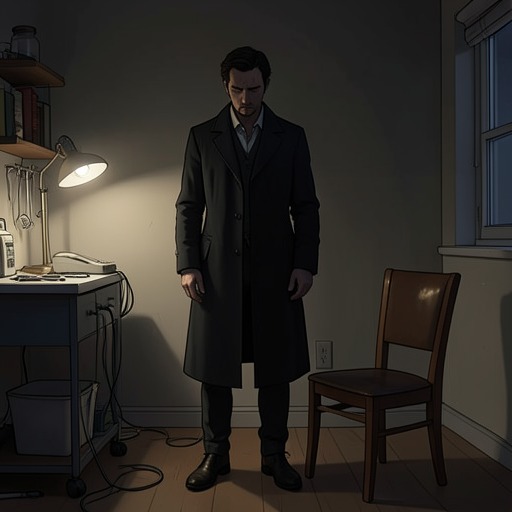
Huang—Cui Feng
The Killing RoomHuang Tsuo and Cui Feng are bound by a transplant that appears at first to be an act of rescue and becomes the means by which Cui secures Huang’s cooperation in an organ-trading operation. Cui waives the fees for a liver transplant for Huang’s seriously ill wife, then uses the resulting debt and her continuing need for care to keep Huang providing official certifications. The relationship turns a life-saving favor into lasting leverage, while Huang’s account distinguishes his initial shock from his later, deliberate failure to ask what his assistance concealed.
The transplant and the debt
Cui approaches Huang with an offer of a transplant when Huang’s wife needs one. Huang says he could never have afforded the procedure, and Cui waives all the fees. The gift therefore answers an urgent need that Huang cannot meet himself; it is not an ordinary exchange between equals. Huang understands the offer as a favor, but later recognizes that Cui has made the favor into an investment in an obligation he can call upon.
That obligation is intensified by the continuing demands of the transplant. Huang’s wife requires constant care and expensive medication to guard against rejection. He believes that taking action against Cui could endanger her, so the medical support that initially seemed to restore hope also narrows Huang’s room to act. His dependence is not presented as proof that he had no responsibility: it explains the pressure under which he remained silent, while leaving intact his awareness that the underlying arrangement was wrong.
From favor to complicity
Cui tells Huang how he acquired the liver. Huang says he was appalled, but felt unable to reverse what had already happened. When Li Yan asks what Cui required of him beyond looking away, Huang describes a more active role: he provided certifications whenever Cui needed them, stating that organs sold abroad had been legitimately obtained from the bodies of executed prisoners. The documents were little more than official letterheads, but, Huang explains, they satisfied Cui’s clients.
The certifications give Cui’s trade a reassuring account of its provenance. Huang recognizes that the familiar claim about organs taken from executed prisoners could serve as a cover for Cui’s activities, even as he describes it as a story used to fuel American suspicion of China. That explanation does not clear Huang. His own account makes clear that the documents helped present the organs as legitimate, while the women whose bodies were later found at Lujiazui were, he says, the actual donors. The contrast between the stated source and the concealed source is the central moral fact of the relationship: Cui supplies the favor, and Huang supplies the appearance of legitimacy.
Knowledge, silence, and responsibility
Huang insists that he did not know the full extent of the operation until the bodies were found at Lujiazui. He also admits that he did not want to know and could not contemplate the possibility that innocent women were the real donors. The distinction matters to his account but does not absolve him. He claims not to have understood the scale or the victims’ identities; at the same time, he acknowledges that he had already learned enough about the organs’ acquisition to be appalled, and continued issuing certifications because he felt unable to jeopardize his wife’s treatment.
Li Yan presses on precisely this gap between knowledge and chosen ignorance. He asks whether Huang ever thought about the women whose lives had been taken, and Huang answers that he did not. In the exchange, Huang’s dependence explains why he feared acting, but his admission that he did not want to know exposes another part of his complicity: he avoided confronting the consequences of the work he was doing for Cui. His defense is therefore neither a denial of the documents nor a claim that the arrangement was innocent. It is an account of how fear for his wife and reluctance to face the truth sustained his participation.
The favor’s final cost
The transplant does not secure the lasting recovery that Huang had hoped it would. Three years later, his wife’s body rejects the liver, and her illness returns to a terminal decline. Huang says that the treatment and medication ultimately came to nothing. This outcome sharpens the imbalance at the heart of Cui and Huang’s relationship: Huang accepts an act he believes has saved his wife, then remains indebted to the person who arranged it, yet the promised benefit proves temporary even as the moral consequences of the favor persist.
During the disclosure, Li Yan identifies the transaction as a trade between Huang’s wife’s life and the lives of the women Cui’s operation harmed. Huang responds with anger and guilt rather than a claim that the comparison is false. His account leaves room to understand his predicament without making his conduct equivalent to Cui’s role: Cui offers the transplant and benefits from Huang’s obligation, while Huang supplies the certifications and chooses not to confront their real implications. The relation is thus both unequal and consequential. It begins in dependence, becomes a channel for concealment, and ends in an exposed debt that has neither protected Huang’s wife nor restored the lives of the hidden victims.